
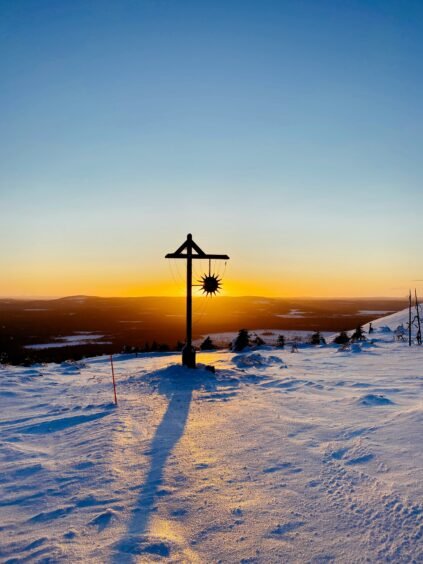
Throughout history, societies across the world have held festivals and ceremonies marking winter solstice, the day of the “sun’s rebirth.” Most often, winter solstice celebrations honored the symbolism of fire and light, along with life, death, the rising sun, and the moon. Saturnalia, for example, was an ancient Roman pagan festival dedicated to honoring the sun god Saturn through offerings and gift-giving. In Mali, a ceremony called Goru is celebrated by the Dogon community where a seven-foot long vessel representing a mythical ark is used to hold offerings to Amma the Creator and other ancestors. Another tradition that we still hear about today is Yule (or Yuletide). Similarly, Indigenous people continue to mark the solstice with storytelling and ceremony. ☀️
So, what is a solstice exactly? Let’s look at the science.
The earth’s tilted axis (23.5º relative to the ecliptic plane) directly impacts the amount of sunlight we do or don’t get throughout the year. This tilt, along with our planet’s orbit, creates both astronomical and meteorological seasons. According to the National Centers for Environmental Information, “…astronomical seasons are based on the position of Earth in relation to the sun, whereas the meteorological seasons are based on the annual temperature cycle.”
When following the astronomical seasons, there are two solstices and two equinoxes to mark the change in meteorological seasons. The winter solstice happens between December 20 and 23, and it’s when the earth’s axis tilts away from the sun, making it the shortest day and longest night of the year for those living in the Northern Hemisphere. In the Southern Hemisphere, it’s reversed. (The word “solstice” derives from the Latin word sōlstitium and translates to “sun stands still.”) This year, the winter solstice will happen on December 21.
There’s not an exact recorded time when humans first started observing the solstice, but monuments like Chichén Itzá, Stonehenge, and the Goseck circle indicate that people have been honoring the astronomical seasons for years.
What is special about the winter solstice?
The winter solstice is special because it marks a powerful turning point where darkness reaches its peak and the light slowly begins to return. Rather than signaling an ending, the solstice represents a quiet rebirth — a reminder that even in the deepest stillness, change is already underway.
Across cultures and traditions, this moment has long been associated with rest, reflection, and renewal, mirroring nature’s dormancy during winter. It’s a time that invites us to slow down, release the pressure to constantly produce, and honor the need for restoration. Emotionally and energetically, the solstice is ideal for inner work: Journaling, meditation, and honest self-inquiry about the year that has passed. Many people use this time to acknowledge lessons learned, process unresolved emotions, and consciously let go of habits, relationships, or beliefs that no longer serve them.
Symbolically tied to themes of death and rebirth, the solstice encourages closure without urgency, allowing space for healing before new growth begins. Celebrations often center around light — candles, fires, and warm gatherings — serving as reminders of hope, resilience, and connection during darker times. Rather than rigid resolutions, this season supports setting gentle intentions or themes for the months ahead, planting seeds quietly instead of forcing outcomes.
The solstice also reconnects us to natural cycles, reinforcing that periods of rest and stagnation are not failures, but essential phases of growth. It’s a grounding alternative to high-energy celebrations, offering a chance for meaningful conversations, solitude, and presence. Ultimately, the winter solstice is a deeply reflective pause — a moment to soften, feel, forgive, and trust that light, clarity, and momentum will return in their own time.
Winter solstice celebrations around the world
- Yule (Northern Europe): Celebrated by ancient Germanic and Norse cultures, Yule honors the rebirth of the sun. Traditions include lighting candles, burning a Yule log, decorating with evergreens, and reflecting on renewal and protection for the coming year.
- Dongzhi Festival (China & East Asia): Dongzhi marks the return of longer days and the balancing of yin and yang. Families gather to eat warming foods like tangyuan (sweet rice balls), symbolizing unity, harmony, and togetherness.
- Shab-e Yalda (Iran & Central Asia): Known as the longest night of the year, Yalda is spent with family reading poetry (often Hafez), lighting candles, and eating symbolic fruits like pomegranates and watermelon to represent life and light overcoming darkness.
- Soyal (Hopi Nation, North America): Soyal is a sacred ceremony welcoming the return of the sun. It involves prayer, ritual dances, and purification practices meant to restore balance and prepare the community for the new agricultural cycle.
- Saturnalia (Ancient Rome): A joyful multi-day festival honoring Saturn, Saturnalia included feasting, gift-giving, role reversals, and public celebrations—many of which influenced modern winter holiday traditions.
- Toji (Japan): The solstice is observed through purification and health rituals, most notably yuzu baths to ward off illness, along with eating kabocha squash to promote strength and longevity during winter.
How can you celebrate the winter solstice?
The winter solstice is a reminder to honor our connection to the natural world. It is a way we can celebrate the change in seasons without traditional holidays, gifts, or decorations. Instead, we can honor winter through rituals and self-care, looking specifically to our ancestors and heritage for inspiration rather than co-opting from others.
“Today, the winter solstice is a reminder to honor our connection to the natural world.”
Here are a few ideas:
-
Consider practicing a pagan yule candle tradition (a tradition with European roots). Create an altar with items that bring you joy and peace, and surround it with candles. Light the candles as a symbol of the sun’s ability to give us both life and light.
-
Wake up early on the day of the winter solstice to watch the sunrise. Close your eyes, and feel the sun’s warmth on your face. Observe how the sun lights up the world around you. Bring a journal and write down any thoughts that come to mind.
-
Create a traditional winter feast with warming foods to eat on the night of December 21. Have fun creating a meal that warms and nourishes the body.
-
Draw a winter solstice bath, adding citrus essential oils to symbolize the energy of the sun.
-
Create something handmade that honors the sun or the natural world, such as a wreath from what you have around your house or backyard. Paint or draw the sun. Grab an instrument you haven’t played in a long time and write a song; then share it with loved ones.
“Wake up early on the day of the winter solstice to watch the sunrise […] Write down any thoughts that come to mind.”
However, you chose to bring rituals and new traditions into your life, make time to appreciate the natural world. Wherever you are, embrace how the air and the sky change, and on the coldest days, know the sun is right around the corner.


1 Comment
How To Celebrate Summer Solstice 2026 – rahatpromos.com
December 28, 2025 @ 18:14
[…] day of the year. (The southern hemisphere’s summer solstice is in December — the north’s winter solstice.) Because the Earth’s axis is tilted at about 23.5 degrees, the summer solstice happens when the […]
Leave Comment